Now Reading: Finding a Complementary Co-Founder: The Skill Matrix Behind Resilient Teams
-
01
Finding a Complementary Co-Founder: The Skill Matrix Behind Resilient Teams
Finding a Complementary Co-Founder: The Skill Matrix Behind Resilient Teams


When founders begin the search for a co-founder, they almost always fall into the “clone trap.” Engineers seek other engineers because code reviews feel comfortable. Marketers look for growth marketers because running ad campaigns together feels familiar. Yet in the unpredictable trenches of early-stage startups, overlapping skill sets create redundant blind spots. The most resilient businesses are forged by complementary pairs – partners who possess starkly contrasting functional talents united by identical core values. Explore founder operating frameworks at the Xan Digital platform.
Key Takeaways
Crucial principles for identifying and evaluating complementary co-founders:
- High-velocity startups require a balance between product creation (building) and distribution (selling).
- Skill sets should be complementary and non-overlapping, while fundamental ethical values must align completely.
- Using a structured skill matrix prevents the clone trap and clarifies executive role delineation early.
- Psychological resilience and emotional stability under severe financial stress outweigh technical brilliance.
- Founders should conduct a mutual trial project before legally incorporating or assigning equity.
The Classic Builder vs Seller Archetype
Every commercial software startup must solve two foundational challenges: can you build the product, and can you get customers to pay for it? In the startup lexicon, this is the classic pairing of the **Builder** and the **Seller**:
1. The Builder (Chief Technology / Product Officer): Obsessed with architecture, database schemas, code performance, and user interface responsiveness. They turn abstract concepts into working software that solves customer pain points cleanly.
2. The Seller (Chief Executive / Commercial Officer): Obsessed with distribution, customer discovery interviews, outbound sales calls, investor relations, and unit economics. They ensure the engineering team builds things people actually want to buy.
When two builders start a company without a seller, they spend eighteen months polishing code for a product nobody knows exists. When two sellers start a company without a builder, they sell vaporware they cannot deliver, burning through outsourced agency retainers. As highlighted in startup ecosystem studies by the Stanford Graduate School of Business, founding teams that unite builder and seller capabilities achieve product-market fit three times faster than homogenous teams.
The Complementary Co-Founder Skill Matrix
Before entering into a legal business partnership, evaluate potential co-founders across four functional pillars to ensure comprehensive operational coverage:
| Operational Pillar | Founder A Competency | Founder B Competency | Optimal Balance Strategy |
|---|---|---|---|
| Technical Engineering | Full-stack development, database architecture | API integrations, lightweight scripting | Founder A owns production code; Founder B assists with testing |
| Product & UX Design | Basic wireframing, technical user flows | High-fidelity Figma UI, customer research | Founder B shapes user experience; Founder A verifies technical feasibility |
| Go-To-Market & Sales | Technical documentation, support triage | Cold outreach, pricing strategy, demo calls | Founder B drives enterprise sales; Founder A delivers technical pre-sales demos |
| Finance & Operations | Developer tool budgets, server costs | Cash flow modeling, legal compliance, billing | Founder B oversees financial runway and business structure |
Notice how responsibilities are distinct. When responsibilities are clearly allocated, founders rarely step on each other’s toes during daily operations. To manage lean cash flow, revenue tracking, and business operations without monthly SaaS subscription bloat, explore our templates for essential SaaS metrics and financial tracking.
Where to Look for High-Caliber Co-Founders
Finding an exceptional co-founder is remarkably similar to professional dating. Random networking events rarely produce deep partnerships. Instead, focus on high-signal environments:
- Former Colleagues and Teammates: The gold standard. You have already seen them perform under corporate deadlines, handle client crises, and interact with peers. You know their work ethic and personal integrity firsthand.
- Open-Source Collaborators & Hackathons: Working together on a GitHub repository or intense 48-hour hackathon project reveals how potential partners solve technical roadblocks and manage sleep deprivation.
- Curated Founder Matching Platforms: Networks such as Y Combinator’s Co-Founder Matching platform provide structured filtering by location, technical background, and commitment level.
Vetting Values vs Vetting Skills
Skills can be learned; core human values and work ethics cannot. When evaluating a prospective partner, probe deeply into their personal philosophy across three critical axes:
1. Financial Horizon and Ambition: Are you building a calm, bootstrapped cash-flow business to fund an independent digital nomad lifestyle, or are you aiming for a high-intensity, venture-backed hyper-growth path targeting an acquisition? If one founder wants dividends and the other wants venture scale, the partnership is doomed from the start.
2. Conflict Resolution Style: How do they react when things break? Do they become defensive, shut down communication, or focus pragmatically on solutions? You will spend more waking hours communicating with your co-founder than with your spouse.
3. Integrity and Transparency: Are they completely candid about bad news? A co-founder who hides customer churn or downplays cash shortfalls will sink your startup before you can intervene. To test your mutual chemistry while testing customer demand, review our tactical guide on product-market fit customer discovery interviews.
Frequently Asked Questions
Can a solo founder succeed without a co-founder?
Yes. Many solo founders build highly profitable software businesses and lifestyle ventures. However, solo founding requires wearing every hat simultaneously – coding, marketing, customer support, and finance – which increases burnout risk during early growth phases.
Should I hire a development agency instead of finding a technical co-founder?
Hiring an agency is viable for building a simple initial proof-of-concept or landing page. However, software products require constant daily iteration based on user feedback. Relying on agencies for ongoing core product features quickly burns through early startup capital without building institutional product knowledge.
How long should we collaborate before officially incorporating?
Work together on a low-stakes trial project for sixty to ninety days. Building a small side tool, running customer interviews, or launching a basic waitlist gives you direct empirical evidence of your collaboration chemistry before signing binding legal documents.
What if my prospective co-founder cannot work full-time immediately?
Asymmetric time commitments are common. Reflect this reality directly in your capitalization planning through dynamic equity slicing or delayed vesting start dates, ensuring that full-time sweat equity receives appropriate compensation.
Establishing Decision Boundaries: The 51/49 Principle
Even the most harmoniously matched co-founders will inevitably confront fundamental strategic impasses. When evaluating potential partners, decide upfront how tough corporate decisions will be finalized. While consensus is great for day-to-day brainstorming, high-velocity startups cannot afford operational paralysis when critical forks in the road appear.
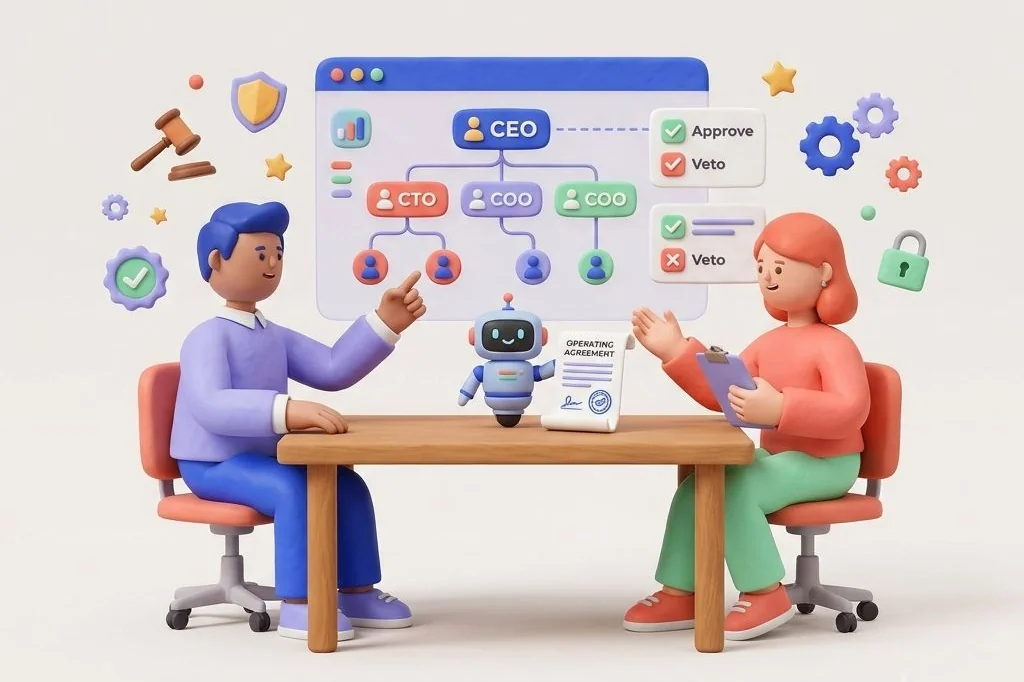
Many successful founding teams adopt the 51/49 principle: designating one partner as the final decision-maker for commercial and corporate matters, while the other holds decisive authority over product and engineering architectures. This clear division of operational command ensures that healthy debates conclude with decisive action rather than prolonged deadlock, allowing the company to maintain momentum in competitive markets.
When both co-founders operate with clear functional boundaries, shared accountability, and mutual respect, the founding team moves with remarkable agility, out-iterating larger corporate incumbents.
Assembling Your Startup Engine
Finding a co-founder is not about discovering an identical twin; it is about finding a trusted partner whose strengths neutralize your weaknesses and whose presence sharpens your execution. By mapping competencies objectively, aligning on lifestyle goals, and testing collaboration through real projects, you lay the groundwork for an enduring partnership capable of building an enduring company. Discover lean founder tools and business frameworks at the Xan Digital startup hub.
Disclaimer: Partnership evaluation frameworks, team structuring strategies, and startup governance models discussed in this article are provided for educational purposes. Founders should seek professional legal and tax guidance when establishing formal corporate entities.